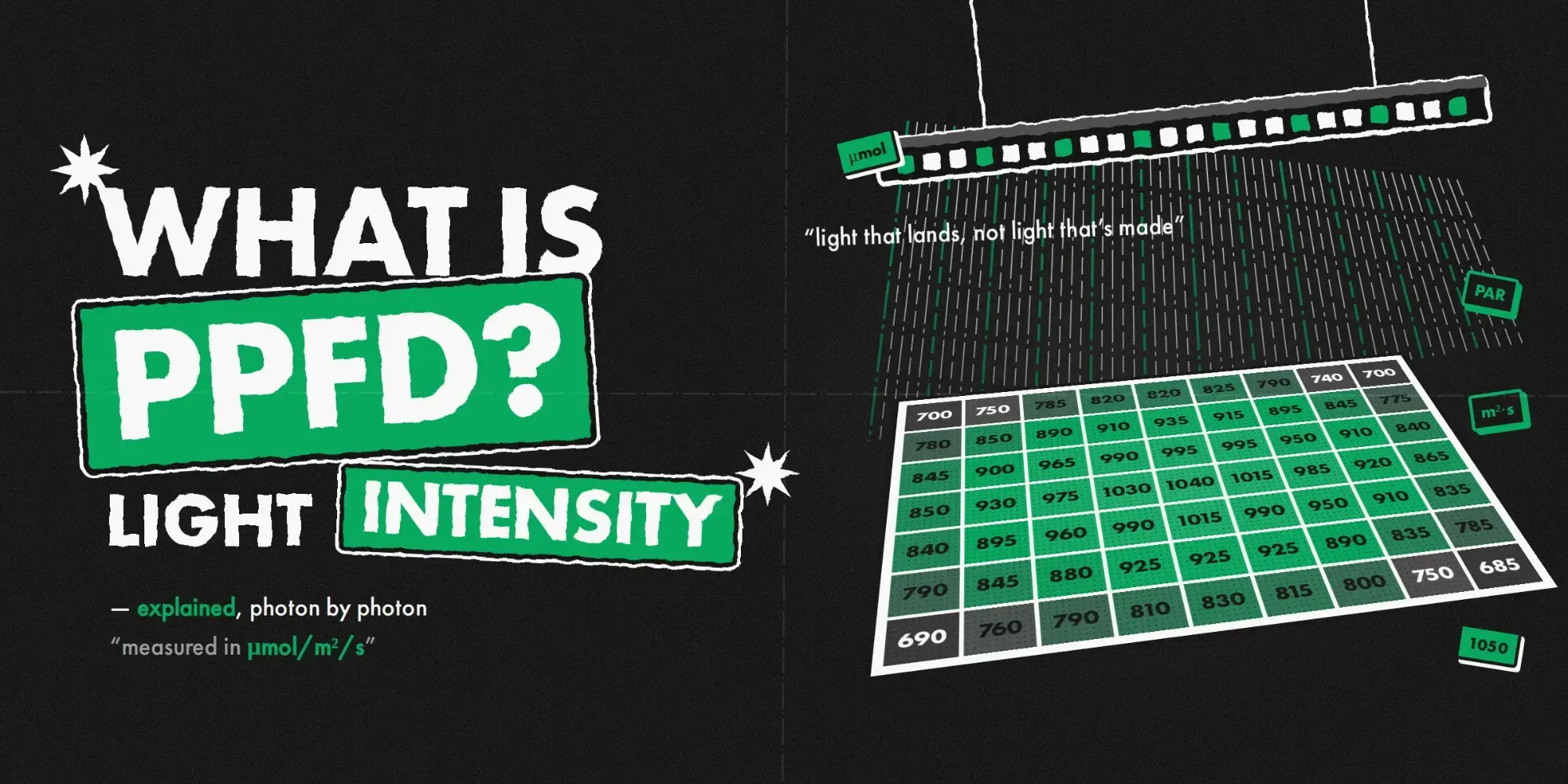
What Is PPFD and What Does It Do to Your Plants?
Mon 26 Oct 2026
Photosynthetic photon flux density (PPFD) is the number of usable light particles landing on one square meter of canopy every second, and it drives yield directly: dry cannabis flower yield rose from 116 to 519 grams per square meter as canopy PPFD climbed from 120 to 1,800 micromoles per square meter per second (Rodriguez-Morrison, Llewellyn, and Zheng, 2021).
What Is PPFD in Plain Terms?
Plants do not respond to brightness. They count photons, the individual particles of light, in the 400 to 700 nanometer band known as photosynthetically active radiation (PAR). University of Missouri Extension describes PPFD as how much instant light reaches the plants in a given area at a set distance, measured in micromoles per square meter per second (Cabrera-Garcia and Ernst).
Think of a rain gauge on a bench. The sprinkler output is one number, but what the plant gets is whatever lands in the cup. PPFD is that cup reading for light. One micromole is roughly 602 quadrillion photons, so a reading of 1,000 means an enormous stream of usable particles hitting every square meter, every second.
How Is PPFD Different From PPF and Lumens?
Photosynthetic Photon Flux (PPF)
PPF is the total photosynthetic light a fixture emits each second, measured in micromoles per second. It describes the fixture, not the plant. Two rooms running identical fixtures can deliver very different PPFD depending on hanging height, fixture spacing, and how much light the walls reflect back.
Lumens, Lux, and Foot-Candles
These units are built around human vision, which is most sensitive to green light. A lamp can look bright to a person while delivering modest PPFD, or look dim and purple while delivering plenty. For plant decisions, PPFD measured with a quantum sensor is the number that counts.
Why the Plant Cares About the Count
Each absorbed photon powers a small slice of photosynthesis, the process that turns carbon dioxide and water into the sugars a plant spends on roots, leaves, and flowers. More photons per second means more sugar per second, up to the point where the leaf machinery is already running at full speed.
What Does PPFD Actually Do to Plants?
In the Rodriguez-Morrison, Llewellyn, and Zheng (2021) trial, single leaves stopped gaining photosynthesis well below 1,800 micromoles per square meter per second, with week five data projecting saturation near 1,532. Yet whole-plant yield kept rising in a straight line, because a full canopy holds shaded and angled leaves that still put extra photons to work.
Higher PPFD also raised harvest index, the share of plant mass that ends up as flower, and produced denser top colas. What it did not change was cannabinoid potency, which held steady across every light level tested. In short, more light grew more flower, not stronger flower.
For a grower, the takeaway is that PPFD is a yield lever with a firm ceiling per leaf but a much higher ceiling per canopy. The trial used LED fixtures and a 12-hour flowering photoperiod, so its results describe an indoor room, not a greenhouse with shifting sunlight.
Why Does PPFD Change Across the Canopy?
PPFD is a reading at one spot, not a property of the fixture. University of Missouri Extension notes that PPFD tends to be higher when the light source is closer to plants, which is why manufacturers list expected PPFD at several hanging heights. Raise a fixture and the same output spreads over more area at lower intensity.
The center of a room usually reads higher than its edges, where fewer fixtures overlap. That is why one number on a spec sheet rarely matches what plants along the walls receive, and why a grid of quantum sensor readings at canopy height tells far more than a single reading under the brightest fixture. Uniformity is what lets an entire bench finish at the same pace.
Signs the Count Is Running Too High
Light is not free for the leaf. In the same 2021 trial, a chlorophyll fluorescence measure of photosystem efficiency (Fv/Fm) declined steadily as leaf-level PPFD increased, an early sign that leaves were working closer to their limit. The trial also ran at ambient carbon dioxide, about 437 parts per million during the day, so its results reflect a room without supplemental enrichment.
Pushing PPFD higher only pays when the rest of the room keeps up. Light intensity is one input among several. Raising it in a room already short on any other input simply moves the bottleneck. Temperature, irrigation, nutrition, and carbon dioxide all set ceilings, and fixture heat climbs with output, which is where a plan for grow light thermal management earns its keep.
How Does PPFD Become Daily Light Integral?
PPFD is a per-second snapshot. Daily light integral (DLI) adds those seconds up across the photoperiod to give the total photosynthetic light a canopy receives in a day, in moles per square meter per day. The math is simple: multiply PPFD by hours of light, then by 0.0036. For example, 500 micromoles for 18 hours gives about 32 moles.
At 1,800 micromoles per square meter per second over a 12-hour flowering day, that works out to roughly 78 moles per square meter per day, the same figure Rodriguez-Morrison, Llewellyn, and Zheng (2021) reported for their brightest treatment. DLI is why a modest PPFD over a long veg day can rival a higher PPFD over a short flower day.
Turning PPFD Into a Lighting Decision
Start by measuring, not guessing. Take quantum sensor readings at canopy height on a grid, compare the average against your target, and check the gap between center and edge. Then decide whether the fix is hanging height, spacing, dimming, or more fixtures. Each choice moves PPFD differently and carries a different electricity cost per mole delivered.
Dimmable fixtures make this easier, since output can be stepped down for young plants and raised as the canopy fills, without moving hardware. Record each change with a fresh set of readings, so the room has a baseline the next time yields shift.
Because every added micromole draws power, high-efficacy LED fixtures make high-PPFD rooms cheaper to run, and many utilities help pay for them. Before you upgrade, review the LED rebates and incentives available in your area.
Frequently Asked Questions
What is a good PPFD for cannabis?
It depends on growth stage, cultivar, and environment. In a 2021 Frontiers in Plant Science trial, cannabis flower yield kept rising in a straight line up to 1,800 micromoles per square meter per second at ambient carbon dioxide, while potency did not change. Most facilities set lower targets and adjust them by stage.
What is the difference between PPF and PPFD?
PPF is the total photosynthetic light a fixture emits each second, measured in micromoles per second, and it describes the fixture. PPFD is how much of that light lands on one square meter of canopy each second. Hanging height, spacing, and room layout decide how much PPF turns into PPFD.
Can I measure PPFD with a lux meter or phone app?
Not reliably. Lux meters are built around human vision and weight green light most heavily, so they misread grow lights, especially red and blue heavy LEDs. A quantum sensor measures PPFD directly in micromoles per square meter per second. Values converted from lux are rough estimates that shift with every light source.
Does higher PPFD increase THC in cannabis?
Not according to Rodriguez-Morrison, Llewellyn, and Zheng (2021). Their trial found no light intensity effect on cannabinoid potency across canopy PPFD levels from 120 to 1,800 micromoles per square meter per second. Higher PPFD raised dry flower yield and bud density, so total cannabinoids per square meter rose with yield, not concentration.
Source: Rodriguez-Morrison, Llewellyn, and Zheng, "Cannabis Yield, Potency, and Leaf Photosynthesis Respond Differently to Increasing Light Levels in an Indoor Environment," Frontiers in Plant Science (May 2021). Available at: Frontiers in Plant Science