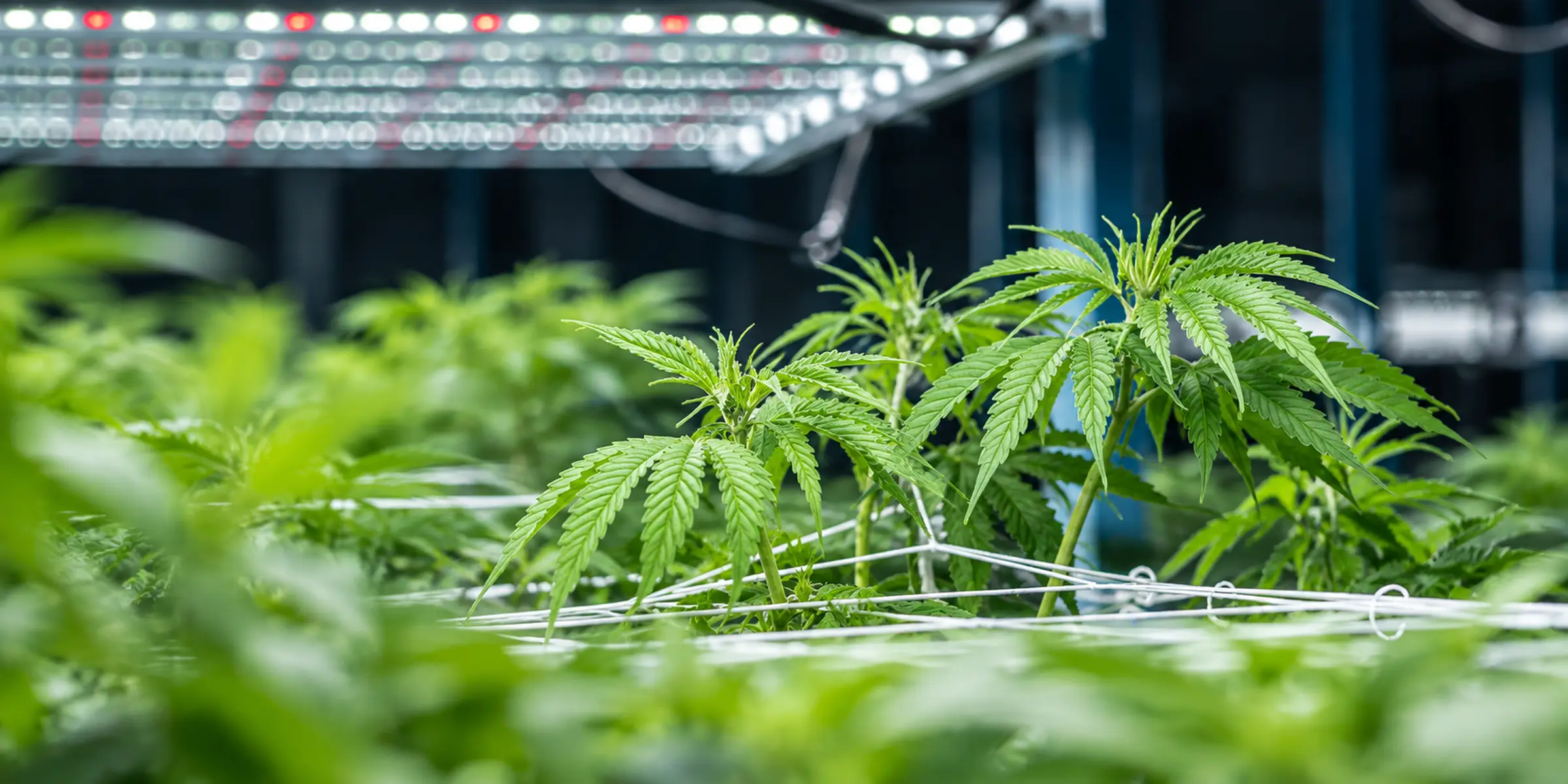
How PPFD Targets Change by Growth Stage, From Clone to Flower
Mon 05 Oct 2026
PPFD targets climb step by step across a crop's life, from roughly 50 to 250 micromoles per square meter per second (umol/m2/s) for rooting clones up to 700 umol/m2/s for flowering cannabis, because each growth stage uses light differently. PPFD stands for photosynthetic photon flux density, the count of usable light photons landing on canopy every second.
What Does PPFD Actually Measure?
A quantum sensor at canopy height measures PPFD by counting only photons in the 400 to 700 nanometer range that plants use for photosynthesis, unlike a light meter built for the human eye. DLI, or daily light integral, adds up every photon over a day, in moles of light per square meter per day (mol/m2/d).
Full summer sun outdoors peaks near 2,000 umol/m2/s, so grow-room targets sit well below outdoor peak intensity. A reading of 300 umol/m2/s means 300 micromoles of usable photons strike each square meter of canopy per second, not a dimmer percentage.
Why Do Light Targets Rise by Stage?
Targets rise because a plant's capacity to use light grows with its root mass and leaf area. An unrooted cutting has little root system to support photosynthesis and almost no canopy to intercept light, so high PPFD mostly produces stress rather than growth.
Clone and Propagation Stage
A 2025 HortScience study from Wageningen University and Research rooted cannabis cuttings under 50, 150, and 250 umol/m2/s. Higher propagation light, up to 250 umol/m2/s, did not reduce how many cuttings rooted, and it increased root dry mass measured 14 days after sticking.
Vegetative Stage
Once clones root, they tolerate far more light. A 2025 Scientific Reports study grew cannabis under constant PPFD of 150, 300, 500, and 700 umol/m2/s, with the lower half of that range, roughly 150 to 500 umol/m2/s, matching the vegetative weeks before flowering starts.
Flowering and Finishing Stage
In that same Scientific Reports (2025) study, a dynamic program, lower PPFD for the first 28 vegetative days then 700 umol/m2/s for the final 44 flowering days, produced up to 10.4 percent more flower mass and 24.8 percent better water use efficiency than one static PPFD held for the full 72 day cycle at equal total light delivered across both programs.
What Happens When PPFD Comes Too Early?
Raising PPFD 4.7 fold over a full cycle raised flower yield 4.1 fold in that same dataset, so more light generally paid off, but the size of the gain depended heavily on timing. Running flowering-level PPFD during the vegetative stage wastes energy on leaf area that is not yet built to convert it into flower mass, according to Scientific Reports (2025).
How Should Growers Ramp PPFD Up?
Growers get better results stepping PPFD up stage by stage rather than running one fixed number from clone to harvest, matching intensity to what each stage's roots and leaf area can actually use. A dedicated lower-output fixture for the propagation room, kept separate from the veg and flower rooms, makes that step-up easier to control, measure, and repeat from one cycle to the next.
What Do Lettuce and Floriculture Crops Need?
Leafy greens follow their own curve. The Cornell University Controlled Environment Agriculture Program (2019) recommends about 250 umol/m2/s for lettuce seedlings after an initial 24 hours near 50 umol/m2/s, then 100 to 200 umol/m2/s of supplemental light during production, targeting a daily light integral near 17 mol/m2/d for Boston bibb cultivars, with some cultivars capping closer to 15 mol/m2/d before tipburn appears.
Purdue University Extension (Lopez, 2010) reports that many shade-intolerant floriculture crops need a minimum of 10 to 12 mol/m2/d during finishing, while propagation DLI of 4 to 11 mol/m2/d speeds rooting and improves cutting quality in bedding plant cuttings.
Getting PPFD Right at Every Stage
No single PPFD number fits a whole crop cycle. The research above points to the same pattern across lettuce, cannabis, and floriculture crops alike: start low while roots and leaf area are still small, then raise intensity in deliberate, measured steps as the plant's capacity to use that light grows, tracking canopy temperature and water use along the way instead of chasing one maximum figure on a single spec sheet.
ILUMINAR Lighting engineers fixtures for each side of that curve, including the Verdidim propagation fixture built for double-tier clone rooms and the higher-output iLogic PLUS series for veg and flower. See the full propagation-to-flower lineup on the cannabis cultivation lighting page, and stage-specific light levels for ornamentals on the floriculture lighting guide.
Frequently Asked Questions
What PPFD should I run for clones?
A 2025 HortScience study from Wageningen University and Research rooted cannabis cuttings successfully at 50 to 250 umol/m2/s, with higher intensity in that range increasing root mass without reducing how many cuttings rooted. Most propagation rooms run toward the lower half of that band to limit water stress on unrooted cuttings.
How much PPFD do cannabis plants need in veg?
Published research on cannabis vegetative growth has tested PPFD from 150 up to 500 umol/m2/s, a range wide enough to cover most commercial veg rooms. Lower numbers in that range suit early veg, with intensity rising as plants build leaf area and root mass, according to Scientific Reports (2025).
What PPFD is best for flowering cannabis?
A Scientific Reports (2025) study found flowering cannabis responded well up to 700 umol/m2/s, and a dynamic program that raised PPFD to that level only after a lower-light vegetative stage out-yielded holding one static PPFD for the whole cycle, producing up to 10.4 percent more flower mass.
Can too much PPFD hurt my plants?
Yes. Running flowering-level PPFD on young, unrooted, or early-vegetative plants mostly causes heat and water stress rather than extra growth, since small plants lack the root mass and leaf area to use that much light. Published trials ramp PPFD up stage by stage rather than starting at the maximum.
What is the difference between PPFD and DLI?
PPFD is an instant reading, the micromoles of usable light hitting one square meter of canopy per second. DLI, or daily light integral, totals every photon delivered over a full day, in moles per square meter per day (mol/m2/d), and is what actually drives a plant’s daily growth.
Source: Collado, C.E. and Hernandez, R., "Vegetative and reproductive stage lighting interactions on flower yield, water use efficiency, terpenes, and cannabinoids of Cannabis sativa," Scientific Reports (December 2025). Available at: Scientific Reports