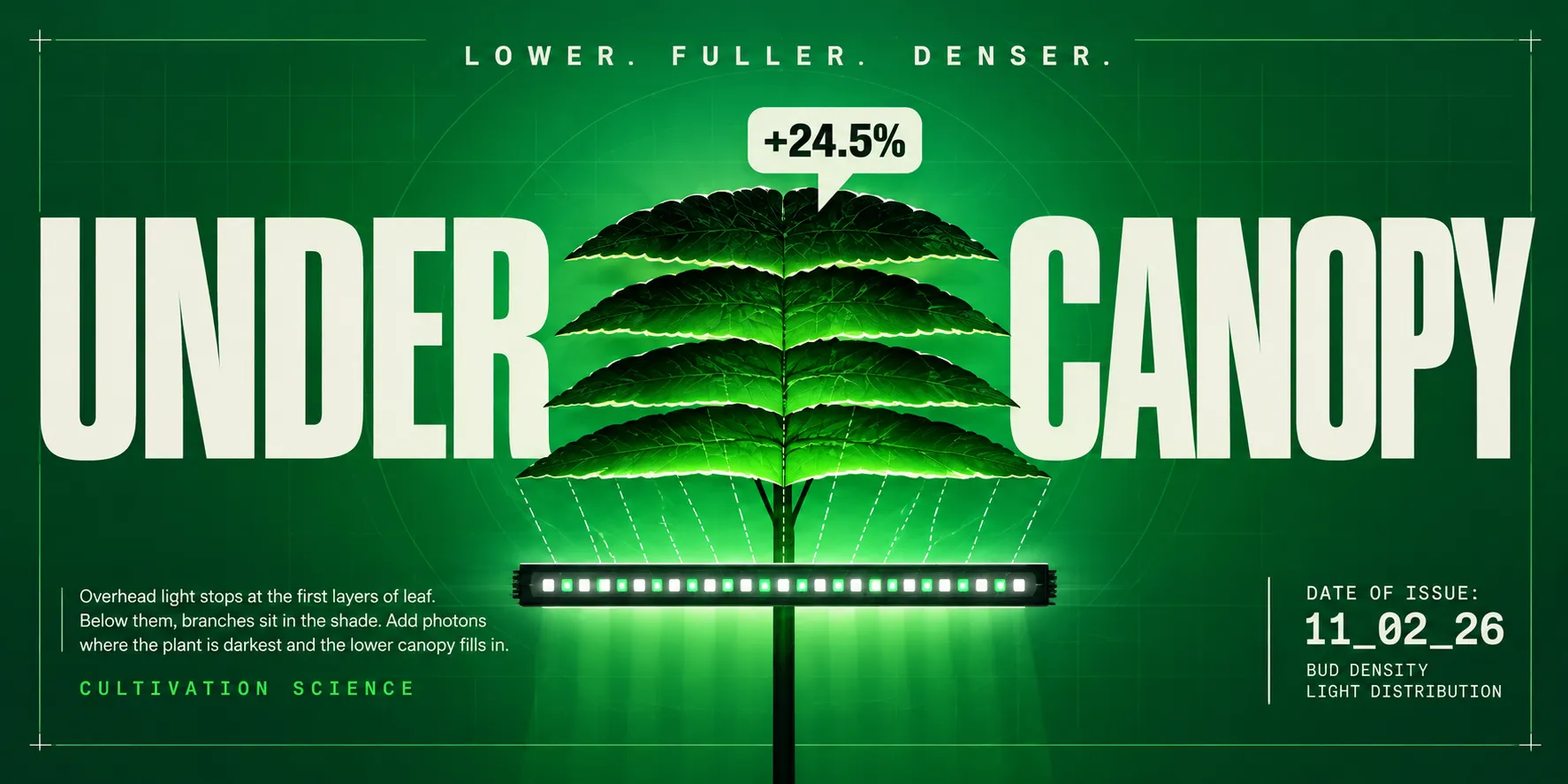
Under-Canopy Lighting and Bud Density
Mon 02 Nov 2026
Under-canopy lighting raised dry flower yield by 19.8 to 24.5 percent in a commercial cannabis trial (Hawley, Graham, Stasiak, and Dixon, 2018), and a 2025 study traced comparable gains to the middle and lower canopy rather than the top colas (Garrido and colleagues, 2025). Lower branches yield less because they receive less light, and the return shows up where photons are added to the darkest part of the plant.
Why Do Lower Branches Produce Less?
Overhead fixtures light the top of the plant first, and every leaf layer shades the one below it. In the Hawley trial, photosynthetic photon flux density (PPFD) at the top of the canopy held at 500 micromoles per square meter per second for most of bloom, while the supplemental bars added just 95 micromoles at the bottom. That gap is the opportunity.
Light and flower density move together. Rodriguez-Morrison, Llewellyn, and Zheng (2021) found that dry inflorescence yield rose linearly with canopy PPFD up to 1,800 micromoles per square meter per second, and that apical inflorescence density also increased linearly with light intensity. Shaded lower branches sit at the bottom of that same curve.
What Did the Research Actually Measure?
Neither study weighed bud density branch by branch, so read the proxies carefully.
Bud-to-Leaf Ratio
Hawley and colleagues (2018) reported that both supplemental spectra significantly raised the ratio of bud to non-bud tissue in both crop cycles. More of each harvested plant was flower and less was leaf and stem, the outcome growers recognize as fuller, more saleable lower buds.
Biomass by Canopy Position
Garrido and colleagues (2025) split each plant into apical, middle, and basal fractions. Subcanopy and inter-canopy lighting increased biomass in the middle and basal parts, while the apical and middle fractions still produced more cannabinoids than the base.
The Gain Outran the Light Added
Hawley and colleagues (2018) noted that the yield increase was disproportionate to the extra PPFD supplied, and attributed it to better light distribution into the lower canopy. That fits basic light-response physiology: a photon landing on a shaded lower leaf does more work than one landing on a top leaf already running near saturation, where each added photon buys progressively less.
Where Does the Yield Gain Come From?
It comes from filling the bottom of the plant and evening it out. In the 2025 trial, dry inflorescence yield rose 24.58 percent with subcanopy lighting and 29.95 percent with inter-canopy lighting, while the coefficient of variation in dry inflorescence weight fell 55 to 62 percent (Garrido and colleagues, 2025). Fewer undersized lower buds means more of the harvest grades as premium flower instead of trim-grade material.
Does Under-Canopy Light Raise Potency?
It raises total cannabinoid output more reliably than concentration. In the second Hawley crop cycle, lower-canopy total delta-9 tetrahydrocannabinol (THC) rose from 21.00 to roughly 22 percent under both spectra, with no significant upper-canopy change. Garrido and colleagues (2025) saw THC yield per plant climb 18.67 to 24.42 percent, even though concentration was higher under top lighting alone, which the authors attribute to dilution.
What Does the Extra Light Cost?
Garrido and colleagues (2025) measured lighting energy rising 13.13 percent with subcanopy lighting and 23.21 percent with inter-canopy lighting. Set against a 24.58 percent yield gain, the subcanopy layout returned roughly 10 percent more dry flower per unit of lighting energy by our arithmetic, which is why the authors rated it the most power-efficient option.
Inter-canopy lighting bought the biggest absolute gain, 29.95 percent, for its 23.21 percent energy increase, which makes it the stronger choice when canopy space, not power, is the binding constraint.
Energy math shifts with every rate structure, so model it per facility before buying. Some utility programs offer incentives for qualified horticultural LEDs, and it is worth reviewing LED rebates and incentives before sizing a supplemental layer.
How Does Spectrum Change the Result?
Spectrum shaped consistency more than it shaped yield. In the Hawley trial, the red-green-blue bars posted the larger gain in the second cycle, 24.5 percent against 19.8 percent, and were the only treatment with a significant gain in the first. The red-blue bars, however, produced the most uniform cannabinoid and terpene profile between upper and lower canopy, which the authors described as a more stable metabolome. The red-green-blue bars also raised several upper-canopy terpenes, including limonene, myrcene, and linalool.
For a commercial operator, that is a real trade. A program selling on consistent lab results across every lot may weight profile uniformity, while a program selling on weight per square foot may weight raw yield. Either way, the spectrum decision belongs in the pilot room, not the purchase order.
Placement Decides Which Branches Benefit
Hawley and colleagues positioned bars beside each row and set their 95 micromole target at 20 centimeters from the lamps. Garrido and colleagues mounted inter-canopy fixtures at one-half and one-sixth of plant height to reach the middle and lower canopy, at a density of 12 plants per square meter. In both cases the light was aimed at branches that still carried flower sites, which is where the added biomass was recorded.
That last point is the one most often skipped. If the lower branches were stripped during canopy management, an under-canopy layer has very little left to work on. Defoliation and lower-branch pruning decisions should be made with the supplemental layer in mind, since the layer only pays on branches left to flower.
A Decision Rule for the Next Cycle
Pilot one room before committing a facility. Measure PPFD at the bottom of the canopy before and after the install, split harvest weight into top, middle, and lower fractions, and track the variation in bud weight rather than only the total. If the lower fraction gains weight and variation narrows, the layer is doing what the research says it should, and fixtures built for that position, such as the ILUMINAR Under Canopy Light, can scale with confidence.
Record the result per cultivar. Both trials tested a single cultivar each, so the response in your own genetics is the number that should drive the facility-wide decision.
Fixtures running inside a dense canopy also change where heat lands, so review grow light thermal management before scaling the layer facility-wide.
Frequently Asked Questions
Does under canopy lighting increase yield in cannabis?
Yes, in published trials. Hawley and colleagues (2018) measured 19.8 to 24.5 percent more dry flower with subcanopy LED bars, and Garrido and colleagues (2025) reported gains of 24.58 percent with subcanopy and 29.95 percent with inter-canopy lighting. The added biomass came mainly from middle and lower branches, which receive the least overhead light.
Will under canopy lights make my lower buds denser?
Likely, though no study has weighed lower-bud density branch by branch. Inflorescence density rises linearly with light intensity (Rodriguez-Morrison, Llewellyn, and Zheng, 2021), and subcanopy lighting raised the bud-to-leaf tissue ratio in both crop cycles of the Hawley trial. More light on lower branches moves them up that density curve.
How much PPFD do under canopy lights need?
Far less than overhead lighting. In Hawley and colleagues (2018), supplemental bars delivered 95 micromoles per square meter per second at the bottom of the canopy against 500 at the top, and still raised yield by up to 24.5 percent. The gain was disproportionate to the added light, so modest intensity placed well goes a long way.
Does under canopy lighting use a lot of electricity?
It adds load, but yield rose faster in testing. Garrido and colleagues (2025) measured lighting energy up 13.13 percent with subcanopy lighting against a 24.58 percent yield gain, making it the most power-efficient layout tested. Inter-canopy lighting used 23.21 percent more energy for the largest absolute gain, 29.95 percent.
Source: Garrido, Corral, García-Valverde, Hidalgo-García, Ferreiro-Vera, and Martínez-Quesada, "Subcanopy and Inter-Canopy Supplemental Light Enhances and Standardizes Yields in Medicinal Cannabis (Cannabis sativa L.)," Plants (May 2025). Available at: Plants, MDPI